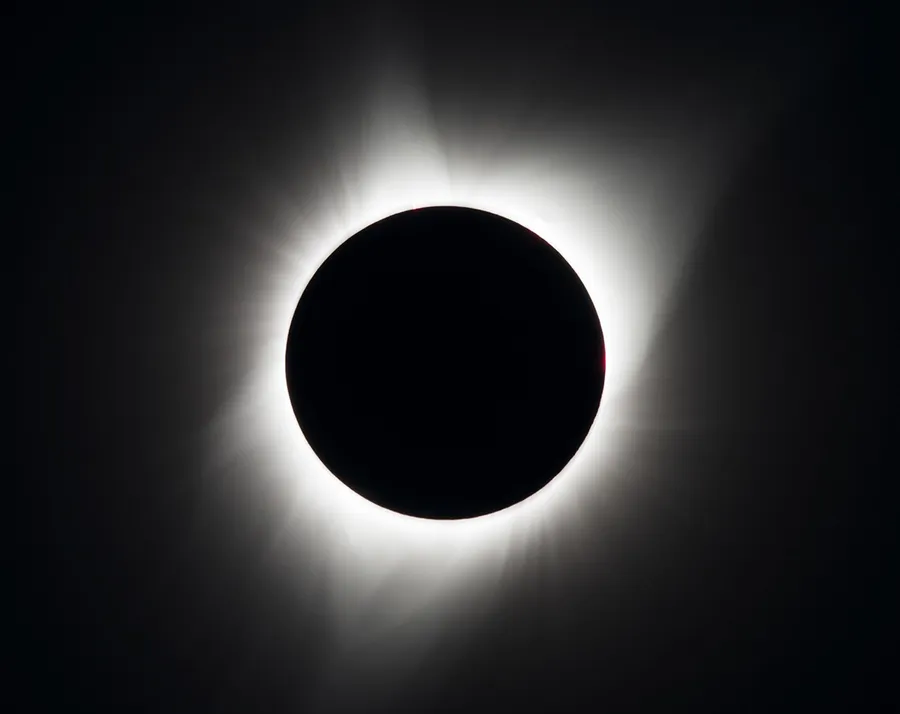
- 6m 23stotality on the axistwo to three times what a total eclipse usually gives
- 9 countriesinside the bandfrom southern Spain to Somalia — the list the calculation returns
- €36the eclipse nights on the Red Sea coastMarsa Alam, two nights for two — third of 10 sampled, Booking.com, 16 August 2026
- €2,502the same two nights in Luxorthe same query that returned €36 at Marsa Alam — Booking.com, 16 August 2026
Where you have to be standing
Totality is not a matter of being roughly nearby. It is a band a couple of hundred kilometres wide, and outside it there is no corona at all — only a bright, disappointing afternoon. A partial eclipse and a total one are not two degrees of the same experience.
Nine countries are inside it: Spain, Morocco, Algeria, Tunisia, Libya, Egypt, Saudi Arabia, Yemen and Somalia — the list is the one the calculation returns, not a list copied from anywhere. Some of the names are a surprise. Mecca is inside the band with 5m08s, two and a half months after the Hajj, while Medina — which people visit on the same trip — is outside it and sees no totality at all.
And the edge is sharp. Tarifa, at the southern tip of Spain, gets 4m39s; Oujda, just across the Moroccan border and only a little further from the axis, gets1m12s. On the Egyptian coast, Marsa Alam gets 5m29s and Hurghada, the airport most people would fly into, is outside the band entirely. The difference between the trip you imagined and a thin one is tens of kilometres, which is why every place named on this site went through the calculation first.
Can you actually go?
Sleeping inside the path is the cheap part
Four nights at Marsa Alam, arriving 31 July and leaving 4 August, for two people: €71Booking.com, 16 August 2026. That is the third-cheapest of the 10 listings the protocol sampled, not the one lucky outlier at the bottom of the page — the cheapest of them was €60. Travelling alone changes nothing — €71Booking.com, 16 August 2026 for the same nights, because these are whole properties priced per unit and not per person.
Luxor is the trap, and it is worth understanding before you book
Luxor has the longest totality in Egypt and the price wall to match: the same two nights, on the same platform, on the same day, came back at €2,502Booking.com, 16 August 2026. And it is a wall rather than a top end — the cheapest of the 10 listings sampled there was €2,325, so there is nothing to trade down to. What that wall looks like, query by query.
Do you need a car?
Only if you sleep in the wrong place. Sleep inside the band and you walk out of your door on the morning of the eclipse and stop there. Sleep at Hurghada or Safaga, which are outside it, and you owe yourself a drive of a couple of hundred kilometres on the one morning of the year when the roads carry everybody else who made the same choice. Both routes are laid out, with what each one costs, on the Marsa Alam page.
The flight is the number nobody has yet
Not the site, and not the airlines either: on 16 August 2026 we measured, route by route, how far ahead a ticket can be bought at all. The answer was 329 days — so a seat on the day of the eclipse first goes on sale around 7 September 2026. Any total trip cost published before then contains a modelled airfare, and we would rather publish an empty column: not on sale yet.
Will the sky cooperate?
In Egypt in August, almost certainly. Cloud cover along this stretch of the path is among the lowest of any eclipse analysed over the last forty-five years, and Luxor runs at four days in five of clear sky. The risk that deserves your attention is not cloud but Saharan dust, which is a real factor on the Spanish and Moroccan end of the path. We treat weather qualitatively until we have loaded the climatology properly — an average copied off the web would be exactly the kind of number this site exists to refuse.
What to book now
Lodging, and only lodging. It is on sale, it is the cheap half of the trip inside the band, and at Luxor it is already the expensive one — a year out, the cheapest of the 10 listings Booking.com showed us there stood at €2,325 for two nights. Leave the flights: they cannot be bought yet, and the sale opens around 7 September 2026. Nothing else on this trip rewards booking early.
Why you can check every number above
Each figure on this site carries the day it was observed and the platform it came from, and the ones we have not measured are labelled as unmeasured instead of being filled in. We stood under the shadow ourselves on 12 August 2026 in northern Spain, and that trip is being written up from its receipts rather than from memory. How we measure, and what money does not buy here.
- NowLodging inside the band is on saleAnd it is cheap: the four mission nights at Marsa Alam were €71 on 16 August 2026
- 7 Sep 2026The eclipse-day flight can first be boughtMeasured horizon of 329 days on Paris → Hurghada, not an airline announcement
- 1 Aug 2027The night that decides your morningInside the band you walk outside; outside it you drive 200 km at dawn
- 2 Aug 2027Totality, around 13:06 in EgyptThe shadow reaches Morocco in the late morning and Egypt in the early afternoon
Start here
The Luxor trap
The longest totality in Egypt, and the price wall standing in front of it. One measured query, one platform, one date — and what each extra second of totality costs.
The cost scale
Five ways to see this eclipse, cheapest to most expensive, each with the risk you take on the morning itself.
Total solar eclipse, 2 August 2027
The one to plan for. The shadow crosses North Africa and the Middle East, and the trip is affordable if you choose the right rung.
Total solar eclipse, 12 August 2026
Already happened, and that is the point: a trip we took, priced from the receipts rather than from a brochure.
How we measure
Why you can check every number on this site, and what we do when we cannot measure one.
We will tell you when we measure
One message when the eclipse-window airfares open and we have measured them, and one when a price we published moves enough to change a decision. Nothing else.
A few messages a year, and one click to leave. We store the address, the day and the page — nothing else, and no newsletter provider is involved.
After 2027
There is a total eclipse in 2028 as well, and the mission does not stop with one date: what we are building is a way of pricing a trip to totality that still works for the next one. We have not published its geometry yet, because we have not run it through the calculation, and the rule on this site is that nothing appears before it does. 2027 is the eclipse within reach of most of the people reading this, and it is the one everything here is about.
Why prices, and not maps
The geometry of an eclipse is settled science and it is already free everywhere. What nobody publishes is the part that actually decides whether you go: the airfare on the day the shadow lands, the hotel that quadrupled, the transfer you did not budget for. We started recording those prices in August 2026, a year out, so that the curve exists when you need it.